
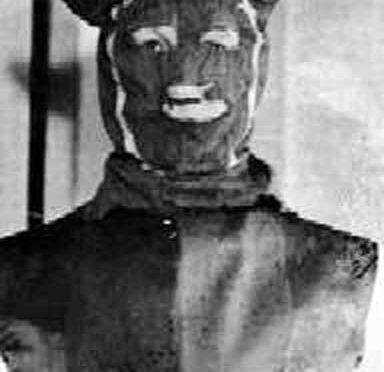
Before heading into the Missouri Ozarks for a story, someone familiar with the area gave me a warning I wasn’t expecting. They told me there was something unusual I needed to watch out for in the woods: Bald Knobbers.
I knew the name, but certainly not that version of it. The only Baldknobbers I knew were the famously silly country music and comedy entertainers associated with Branson. But the person who warned me described something much darker—secretive gatherings, strange regalia and people you supposedly didn’t want to encounter in remote areas. I have found no credible evidence that an organized Bald Knobber group exists in Missouri today, but the person had previously given me surprisingly accurate information about secretive organizations. That was enough to send me down the rabbit hole.
I recently explored that warning, the real history of the Bald Knobbers and some of my own experiences with strange gatherings in remote places in a new episode of the Dark Outdoors podcast, “They Warned Me About the Bald Knobbers.”
Listen to the episode:
Spotify: https://open.spotify.com/episode/6i2V75hcKA6xD46vahBgPH?si=7462473387924aab
Apple Podcasts: https://podcasts.apple.com/us/podcast/they-warned-me-about-the-bald-knobbers/id1630809603?i=1000783368325
What I discovered while researching the episode was stranger than the warning itself because the real Bald Knobbers were not folklore.
Secret Meetings in the Ozarks
The Bald Knobbers emerged in southwest Missouri during the 1880s, when parts of the Ozarks were struggling with crime, violence and divisions that remained after the Civil War. The original Taney County movement organized under Nat Kinney and presented itself as an answer to lawlessness.
Their name came from the bald knobs of the Ozarks, including the kind of isolated elevated country where the organization gathered. Snapp’s Bald, north of Kirbyville, is identified as the location of an early meeting.
That outdoor connection immediately interested me.
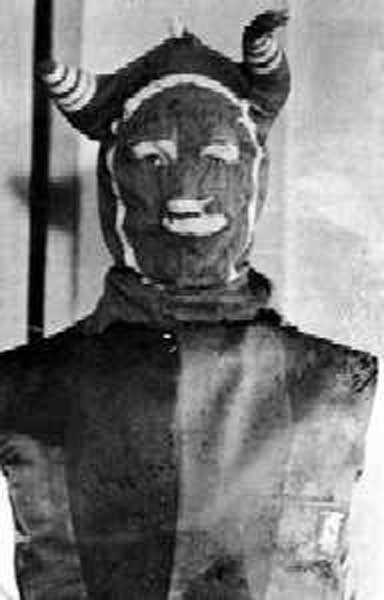
Long before someone warned me about people supposedly using Bald Knobber imagery in modern Missouri, real men were gathering secretly in remote Ozarks country.
Whatever motivations existed at the beginning, vigilantism went into very dark territory. The Bald Knobber movement became associated with intimidation and violence, and the Missouri State Archives records Bald Knobber vigilantism that included men being taken from jail and hanged from a tree along Swan Creek.
Then the movement spread.
The Masks
The image most people now associate with the Bald Knobbers largely comes from the Christian County faction.
These men took the imagery to another level. The Missouri State Archives notes that Christian County Bald Knobbers used initiation rites and esoteric signs and wore what were described as hideous masks.
And hideous is an appropriate word.
The surviving imagery depicts dark head coverings with grotesque faces and horns projecting upward. They look more like props from a horror movie than something worn by actual men in nineteenth-century Missouri.
But men really wore them.
Imagine being in an isolated part of the Ozarks after dark and seeing several figures wearing those masks coming toward you. There is nothing paranormal about that scenario. That’s what makes it disturbing.
Strange People in the Woods
This is where the Bald Knobber story intersects with something I’ve investigated repeatedly with Dark Outdoors.
I’ve received accounts of people encountering strangely dressed individuals in remote outdoor locations. Some involve hooded figures. Others involve fires, ceremonies or gatherings that witnesses interpreted as occult activity.
The obvious temptation is to immediately attach a supernatural explanation to these encounters.
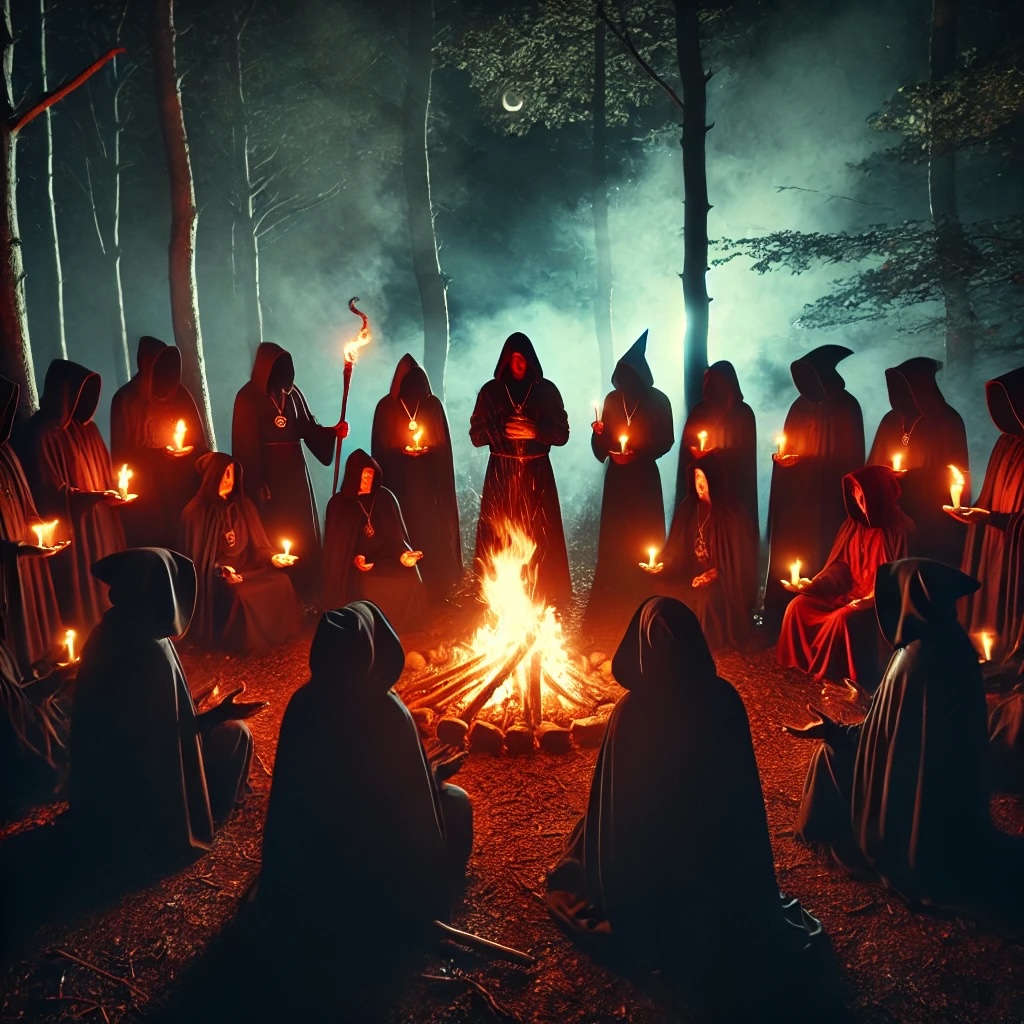
History tells us to be careful about doing that.
People have been putting on masks, robes and hoods and gathering away from public view for a very long time.
Check out our Mystery of the Hooded Ones investigation here.
I know that from personal experience.
When my wife and I were first dating and I was still in high school, we were driving down a dark road when we saw what initially appeared to be the woods on fire. As we got closer, we realized what we were actually seeing.
A group of Ku Klux Klansmen was gathered around a burning cross.
We got out of there.
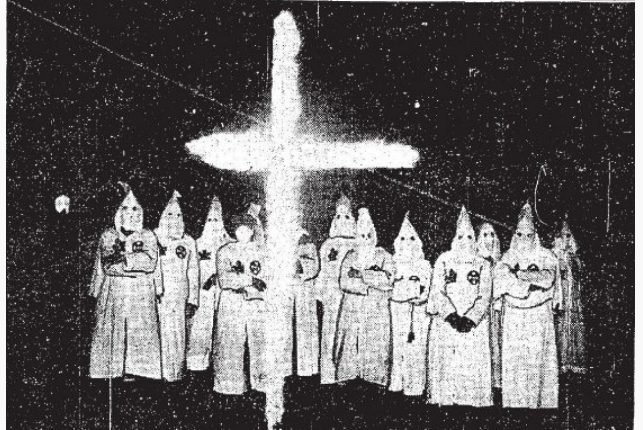
It was frightening, but there was nothing supernatural about it. We had simply driven upon a group of people conducting something they obviously weren’t doing in the middle of town in broad daylight.
That experience has stayed with me when investigating reports of unusual human activity in the outdoors.
The Hood Isn’t Always White
There’s another strange wrinkle involving Klan regalia that illustrates how difficult interpreting these encounters can be.
Most Americans immediately associate the Ku Klux Klan with white robes and pointed white hoods. Historically, however, Klan organizations have also used different-colored robes and markings to signify leadership positions and other roles.
Green, black, purple and other colors have appeared in Klan regalia.
Imagine encountering several people wearing green robes and pointed hoods in the woods without knowing any of that history. What would you think you had encountered?
A cult?
An occult ceremony?
Some strange secret society?
That’s one of the reasons eyewitness accounts of strangely dressed people need to be examined carefully. A witness can accurately describe what they saw while being completely wrong about what it represented.
Old Symbols, New People
This brings me back to the Bald Knobbers.
I found no credible evidence that the nineteenth-century organization somehow survived intact into modern Missouri. I’m not making that claim.
But organizations, subcultures and individuals borrow imagery from the past constantly.
We’ve examined this while investigating reports for Dark Outdoors involving hooded figures and alleged ritual activity. Elements associated with occult movements, fraternal organizations, ancient religious traditions and modern groups sometimes overlap visually without those organizations having any actual relationship to one another.
A robe is a robe. A hood is a hood. A mask is a mask.
The meaning comes from the people wearing it.
So could someone today acquire or manufacture a Bald Knobber-style mask and wear it in the Missouri woods?
Certainly.
Would that make them a Bald Knobber?
No.
But imagine being the person who encounters them.
From Vigilantes to Branson
The other remarkable part of this story is how dramatically the Bald Knobber name changed.
In 1959, the Mabe brothers began performing music and comedy for visitors to Branson. They eventually adopted the Baldknobbers name and deliberately took it in a positive direction, using a piece of Ozarks history as the identity for an entertainment act.
The Baldknobbers helped establish the live entertainment formula that became synonymous with Branson.
That’s the version I knew.
For most of my life, if someone said “Baldknobbers,” I thought of goofy comedy and country music.
Now I think about something else entirely.
What Would You Do?
I still don’t know what was behind the warning I received before heading into the Ozarks.
Maybe it was simply regional folklore that survived long after the original Bald Knobbers disappeared. Maybe somebody had seen people borrowing the imagery. Maybe stories have been repeated and embellished for generations.
I can’t prove otherwise.
But I also know that strange human activity in remote places isn’t something invented for horror movies or paranormal podcasts. History is filled with secret meetings, masked vigilantes, clandestine ceremonies and people deliberately choosing isolated locations where they believed nobody else would see what they were doing.
I’ve unexpectedly encountered something like that myself.
That’s why if I’m walking through the Missouri woods someday and see a black horned mask staring back at me from between the trees, I’m not going to stick around and ask whether the person wearing it can document his historical connection to the Bald Knobbers.
Some mysteries are better investigated from a distance.
Because the outdoors has a dark side.
Chester Moore