
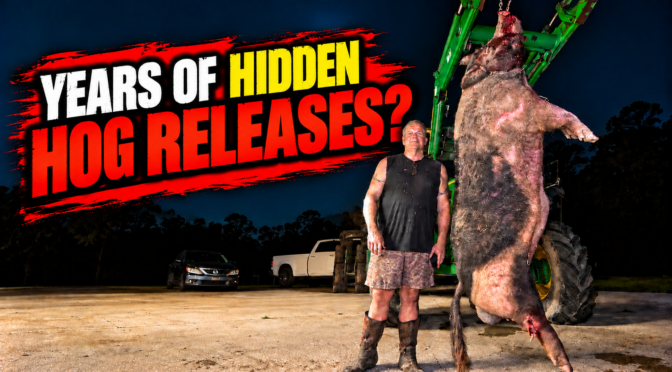
The 725.8-pound feral hog taken in Southeast Texas has generated a tremendous amount of attention since I first reported on it.
Its incredible size immediately got people’s attention, but then viewers started focusing on something else. The massive animal was black and white, and some questioned whether a hog that looked like this and weighed more than 700 pounds could really be feral.
It was.
This was a free-ranging feral hog, and its weight wasn’t someone’s field estimate. The animal was photographed on a scale registering 725.8 pounds.
But the debate made me connect some dots I hadn’t connected before.
For years, I’ve known about giant domestic hogs being released at different locations in this region. That information takes on a new dimension when you consider an animal like this one and the tremendous variation found among feral hogs.
My new video looks at that history, what actually makes a hog feral and how past releases could potentially help explain some of the enormous and unusual-looking feral hogs roaming Southeast Texas.
WATCH THE NEW VIDEO
There are some important distinctions here.
A feral hog doesn’t have to look like the stereotypical lean, black, long-snouted hog many people picture when they hear the word “feral.” Domestic swine can escape or be released and become feral. Their descendants can also reproduce with other free-ranging hogs, contributing to the tremendous variation in size, coloration and physical characteristics found in feral hog populations.
In other words, domestic characteristics don’t automatically make a free-ranging hog somebody’s pet or a barnyard animal.
And that’s where this story gets much more interesting.
I’ve known for years about giant domestic hogs being released at different locations in this region over a long period of time. I knew about these releases long before this 725.8-pound hog appeared.
What I hadn’t done was connect that history with the larger story of giant feral hogs in Southeast Texas.
I’m not claiming this particular hog came from one of those releases because I don’t have evidence connecting this individual animal to a specific release. What we don’t know is the complete ancestry of this hog.
But that doesn’t change what it was when it was killed.
It was a free-ranging feral hog.
The more intriguing question is whether the history of giant domestic hog releases could help explain some of the extraordinary size, coloration and other characteristics occasionally seen in feral hogs in this region.
Could some of those genetics still be represented in hogs roaming Southeast Texas today?
That’s a question worth investigating, and it’s a much bigger story than simply arguing over what the word “feral” means.
The 725.8-pound weight is documented. The animal was free-ranging. The history of giant domestic hog releases in the region is real.
What we don’t know is exactly how all those pieces fit together.
But I’ve connected enough of the dots to know there’s more to investigate.
And I don’t think we’re finished with the giant hog story yet.
Because the outdoors has a dark side.
Chester Moore
Dark Outdoors®
Dark Outdoors investigates terrifying encounters, unsolved mysteries, true crime and dangerous wildlife—because the outdoors has a dark side.
Follow Chester Moore on the following social media platforms
@gulfgreatwhitesharksociety on Instagram
To support the efforts of Higher Calling Wildlife® click here.
Subscribe to the Dark Outdoors podcast on all major podcasting platforms.
Higher Calling Wildlife on Facebook
Email Chester at chester@chestermoore.com.