BEAUMONT, Texas — The Dark Outdoors® Podcast earned First Place for Overall Podcast Excellence at the 35th Annual Press Club of Southeast Texas Excellence in Media Awards. Dark Outdoors also earned First Place honors for Best Blog and Best Video Storytelling, demonstrating the success of the brand across podcasting, digital media, and documentary storytelling.
The awards were part of a larger showing in which creator and host Chester Moore earned eight First-Place awards overall while competing against mainstream television, radio, print, and digital media organizations from across Southeast Texas.
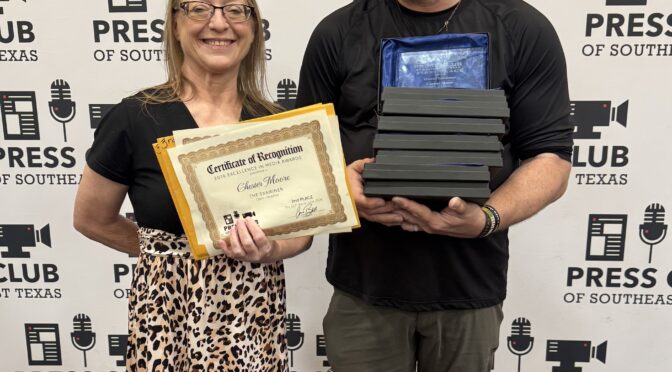
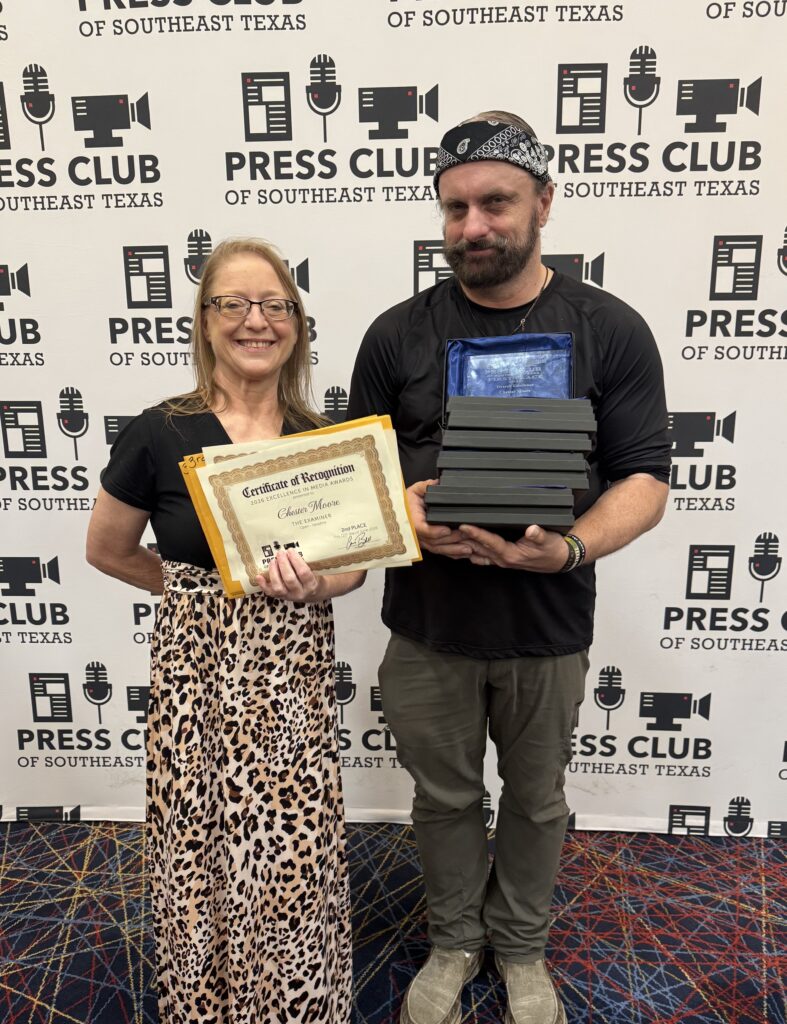
Chester Moore and his wife Lisa at the 2026 Press Club awards.
The award marks the third consecutive year Dark Outdoors has received top honors for podcasting excellence, underscoring the program’s impact and growing audience.
Earlier this year, the Dark Outdoors Podcast also earned Best Podcast honors from the Texas Outdoor Writers Association, giving the program major recognition from both mainstream media and outdoor media organizations.
Dark Outdoors explores the intersection of true crime, unsolved mysteries, and human-wildlife conflict through compelling storytelling rooted in the outdoors.
“Winning for Overall Podcast Excellence is especially meaningful because it recognizes the entire program,” Moore said.
“It is an honor to be recognized among such a talented group of hardworking journalists and media professionals. The Excellence in Media Awards showcase some of the best work being done in our region, and I am grateful to be included among those recognized.”
The Dark Outdoors Podcast features stories ranging from unsolved mysteries and true crime cases to remarkable wildlife encounters and conflicts between humans and animals. Through interviews, investigations, and narrative storytelling, the program examines stories where the outdoors and real-life events intersect.
Dark Outdoors also earned First Place for Best Video Storytelling for Wild Men in Search of Lost Trout and Feral Humanity, a documentary project created by Moore in partnership with author and investigator Lyle Blackburn and videographer/editor Paul Fuzinski.
The documentary exemplifies Dark Outdoors’ commitment to investigating unusual and compelling stories connected to the outdoors.
In addition to the podcast and documentary honors, the Dark Outdoors blog captured First Place in the Best Blog category. The blog honor further demonstrates the strength of the brand as a destination for original storytelling and investigative reporting.
“People are fascinated by mysteries,” Moore said.
“When those mysteries intersect with the outdoors and real-life events, they create stories that stay with you. Dark Outdoors was created to explore those stories and share them with audiences in a meaningful way.”
The awards highlight the growing reach and impact of the brand as a distinctive voice in podcasting, documentary filmmaking, and digital media.
For media inquiries, interviews, or speaking engagements:
The first time my friend and filmmaker Paul Fuzinski and I went into the Everglades and Big Cypress Swamp to investigate reports linked to the Skunk Ape, we approached it as a field problem, not a folklore story.
Florida’s Bigfoot phenomenon has persisted for decades, and we wanted to understand whether some of its core elements — particularly vocalizations and behavior — could point toward feral primates or another biological explanation rooted in the landscape itself.
We went to listen.
South Florida at night is a different world. During the day, the swamps are alive with birds, insects, and human noise bleeding in from roads and towns. After dark, that noise collapses into something more focused. Sound carries farther. Depth becomes difficult to judge. You begin to hear layers instead of individual animals.
It was creepy but cool in The Everglades searching for feral monkeys and apes.
We were working a location that had produced repeated reports of people hearing what they described as “howler monkey–like vocalizations.” These weren’t internet stories or secondhand rumors. They were firsthand accounts from people who knew the woods well enough to recognize when something didn’t belong.
Here’s the Wild Man of the Woods episode from the trip.
After sunset, we shut down the lights and let the swamp settle. Later, we played primate calls in the forest. It was response testing. If something was there, we wanted to know how it behaved.
That night didn’t provide answers.
But it raised better questions.
Why the Southern Bigfoot Narrative Doesn’t Fit Cleanly
Most Bigfoot discussions default to the Pacific Northwest: massive forests, low human density, and distances measured in days of walking. The South doesn’t work like that. Our wild places are fragmented, wet, and biologically dense. They hide animals differently.
Howler monkey.
In the American South — and especially in Florida — the issue isn’t how something avoids being seen. It’s how something avoids being identified.
Swamps distort sound. Vegetation absorbs light. Heat, humidity, and rainfall erase tracks quickly. And unlike the Pacific Northwest, the South has a long, documented history of escaped and released exotic animals, including primates.
That single fact alone demands a different conversation.
Feral Primates Are Not Hypothetical
Florida has hosted non-native primates for decades. Escaped monkeys have survived longer than expected. Small populations have persisted. Primates are intelligent, adaptable, and highly capable of learning how to avoid people.
If even a small number of larger primates — whether escaped, released, or illegally imported — found refuge in deep, inaccessible habitat, their behavior would not resemble zoo animals.
They would behave like wild apes.
This possibility becomes especially relevant when you examine southern Bigfoot reports that don’t line up neatly with the classic Pacific Northwest model.
Some vocalizations reported in the South, particularly those described as long, rolling, guttural calls, align far more closely with howler monkeys than with bears, cats, or known North American wildlife.
That observation is not theoretical. It is based on direct comparison.
During my work investigating reports in Texas and Louisiana, I encountered vocalizations that didn’t match any North American species I knew. I’ve heard cougars, black bears, feral hogs, bobcats, owls, and even jaguars in captivity. None of them produced the sounds I heard in the field.
The closest comparison came years earlier during an excursion into the rainforests of Venezuela, where I encountered howler monkeys. The tone, the power, and the rolling nature of the calls were strikingly similar, though the sounds reported in the South were often more aggressive and varied.
In Texas near the town of Dilley is a feral population of Japanese macaques that have been there since the 1970s.
They are linked to the Born Free Sanctuary and are descendants of animals brought into the United States from their native Japan in the 1970s. There is without question free-ranging monkeys all around that area and I have received numerous photos from hunters in the area over the years.
A Japanese macaque photographed at a deer feeder near Dilley, TX.
How many have escaped the sanctuary over the years or are living in the wild is debatable but their presence in the area is not. And it’s intriguing that these monkeys, sometimes called ‘snow monkeys” due to famous photos showing them near Mount Fuji in the winter have adapted quite well to south Texas hot, dusty habitat.
Florida is also home to thriving communities of non-native monkeys that have captured the imagination of locals and tourists alike.
The story of Florida’s feral monkeys begins decades ago, with the importation of exotic wildlife for the amusement of tourists. In the early 20th century, the Silver Springs attraction in Ocala imported rhesus macaques from Asia, initially as a novelty for their jungle boat tours. These monkeys, however, managed to escape and establish themselves in the surrounding forests.
Florida is currently home to two main species of feral monkeys – rhesus macaques and vervet monkeys. Rhesus macaques are known for their distinctive red faces, while vervets are characterized by their striking blue scrotums (in males) and greenish-gray fur. Both species have adapted remarkably well to their new environment.
Rhesus monkeys in Florida.
Feral monkey populations in Florida are found primarily in three areas:
Silver Springs State Park, Ocala: This is where it all began. The rhesus macaque population here has thrived for decades. They are often seen near the park’s waters, providing visitors with an unexpected wildlife encounter.
Homosassa Springs Wildlife State Park: Located along Florida’s Gulf Coast, this park is home to a population of rhesus macaques. They share the habitat with manatees and other native wildlife, creating a unique ecosystem.
Dania Beach and Fort Lauderdale: In the southern part of the state, vervet monkeys have established a presence.
The presence of feral monkeys in Florida has sparked debates about their ecological impact. Concerns include competition with native species for resources and the potential transmission of diseases. Research is ongoing to assess the extent of their impact on local ecosystems.
These feral monkey populations have become a tourist attraction of their own. Visitors flock to Silver Springs State Park and Homosassa Springs Wildlife State Park to catch a glimpse of these charismatic primates. Local businesses have also capitalized on the vervet monkeys in the Dania Beach and Fort Lauderdale areas, offering monkey-watching tours.
tions in Florida presents unique challenges. Their adaptability and reproductive rates make it difficult to control their numbers. Efforts have been made to sterilize some individuals to slow population growth, but this approach remains controversial.
A story in The Guardian details an interesting note about one of these populations.
“Researchers at Florida Atlantic University (FAU) say they have traced the colony’s origins to the Dania Chimpanzee Farm. The South Florida Sun Sentinel reported on Wednesday there was a monkey escape from the farm in 1948, with most of the monkeys recaptured. But not all of them. The rest disappeared into a mangrove swamp, where their descendants live today. The FAU team said the colony currently numbers about 41.”
The facility had numerous chimpanzees and was not the only facility with apes in Florida.
According to Roadside America, Mae Noell’s Chimp Farm was a resilient gulf coast retirement home for gorillas, orangutans, and chimps. It was closed in 2007.
Cryptozoologists have pondered if reports of skunk apes that look more orangutan-like than standard bigfoot repots could be the result of surviving and perhaps breeding populations of escaped apes.
One of the more interesting cryptozoological reports tied to skunk apes of the last 25 years involves the case of Florida’s mysterious Myakka Ape.
The Myakka Ape photo. Looks like an orangutan, doesn’t it?
Loren Coleman reported on this orangutan-like creature that allegedly was taking fruit off of a woman’s porch near the Myakka River in Florida. Photos were mailed to local law enforcement. It looks very much like an orangutan, but no one has been able to prove exactly what the creature is.
There are numerous reports of primates in the South that do not fit the normal bigfoot profile. Could these be the results of feral monkey or ape sightings?
Loren Coleman and Patrick Huyghe weigh in on this topic in their book The Field Guide to Bigfoot and Other Mysterious Primates.
They identify a classification called “Giant Monkeys”.
“Some of the mystery primates around the world describe what appear to be enormous monkeys.”
They talk specifically about the “devil monkey”, a strange giant monkey that apparently has an attitude. This isn’t the place to dive deep on these reports, but I thought feral primates and strange cryptid monkeys deserved a mention in the discussion of Bigfoot South.
The most interesting report of all is linked to East Texas conservation giant, the man credited with conserving the Big Thicket Lance Rosier. It is covered in Pete Gunter’s A Challenge For Conservation.
“It seems that one day someone found the remains of what was described as a baboon alongside a Hardin County highway. The story goes that a passing one ring circus had a passing in its meager menagerie and simply dumped the remains.”
It was reportedly brought to Rosier for identification.
He said, “From the look on its face and its stooped neck, and the callouses on the seat of its britches, I’d say it’s a retired East Texas domino player.”
Sounds like a baboon to me.
Feral apes would not explain all or even most of the reports in Florida but they could explain some of them.
And I personally would love to have a camera in hand coming face to face with a feral orangutan in the deep Everglades.
It would be scary but also quite awesome!
(If you have encountered a feral primate, heard strange vocalizations or seen something unusual in the woods email your report to chester@chestermoore.com.
Chester Moore
Follow Chester Moore on the following social media platforms
It’s our annual Halloween Monster Special! Lyle Blackburn returns to Dark Outdoors® the podcast to dive into the legends of Momo, the Lizard Man, and the Lake Worth Monster in this chilling cryptid deep dive.
In this special Halloween edition of the Dark Outdoors podcast, we welcome back Lyle Blackburn—renowned cryptozoologist, author, and monster hunter—for our Annual Monster Episode. This time, we’re plunging deep into the chilling backwoods lore of Momo the Missouri Monster, the swamp-dwelling Lizard Man of Scape Ore Swamp, and Texas’s own Lake Worth Monster.
These aren’t your average urban legends. These regional cryptids have sparked mass hysteria, eyewitness encounters, and intense investigations. Lyle unpacks the folklore, historical sightings, and what makes each of these monsters so unique in the world of American cryptozoology.
Whether you’re a lifelong believer or a curious skeptic, this episode will make you think twice before heading out into the woods after dark.
Watch The Wild Men Documentary!
Speaking of Lyle Blackburn, he is a huge part of the latest Dark Outdoors documentary which is perfect for a Halloween viewing.
The new documentary Wild Men: The Search for Feral Humans, Lost Tribes & Primitive Humanity takes you beyond the edge of civilization—into the deep wilderness where the line between man, myth, and memory disappears.
Filmed in out of the way places in Texas, Wild Men explores the shocking possibility that humans who vanished from history may still walk among us.
This documentary is getting a great response and is yielding new reports of possible “wild men”.
Have you ever encountered anything like we cover in the documentary? If so, please email your report to chester@chestermoore.com.
Don’t Forget to Subscribe
There’s something out there in the shadows — and if you’re here, you already feel it. Before you scroll any further, take action and subscribe to Dark Outdoors to get this free Bigfoot decal!
✅ Subscribe right now
✅ Then email your mailing address to → chester@chestermoore.com and put “Bigfoot Decal” in subject line.
📦 When you do, you’ll receive our exclusive Dark Outdoors Bigfoot decal — featuring the glowing-eyed beast from the wilderness beyond imagination.
Chester Moore
Follow Chester Moore on the following social media platforms
There’s something out there in the shadows — and if you’re here, you already feel it. Before you scroll any further, take action and subscribe to Dark Outdoors to get this free Bigfoot decal!
✅ Subscribe right now
✅ Then email your mailing address to → chester@chestermoore.com and put “Bigfoot Decal” in the subject line.
📦 When you do, you’ll receive our exclusive Dark Outdoors Bigfoot decal — featuring the glowing-eyed beast from the wilderness beyond imagination.
Get this decal for subscribing!
This decal is not for sale. The only way to get one is by joining the Dark Outdoors Insiders.
Supplies are limited — make sure you claim yours before they disappear into the woods…
What Is Dark Outdoors?
It is the only podcast that explores the mystery, danger, and true-world strangeness that lurks in the wild.
We dig into:
Real wilderness disappearances
Terrifying wildlife encounters
Backcountry crime & survival stories
Legends and creatures the mainstream ignores
Interviews with experts, trackers & investigators
If you’ve ever stared into the timberline and felt like something was staring back — this show is for you.
Why Join the Dark Outdoors Community?
When you subscribe at DarkOutdoors.com, you get:
🚨 New episode alerts — no algorithm blocking you
🕵️♂️ Exclusive field notes & stories
🎁 Entry into special giveaways & events
👣 The Dark Outdoors insider experience
🧟♂️ Plus… your limited-edition Bigfoot decal
That’s right — subscribe + email me your mailing address and the monster arrives at your door.
Ready to Step Into the Unknown?
This isn’t just a podcast — it’s a community of explorers who embrace the wild, the intense, and the unexplained.