BEAUMONT, Texas — The Dark Outdoors® Podcast earned First Place for Overall Podcast Excellence at the 35th Annual Press Club of Southeast Texas Excellence in Media Awards. Dark Outdoors also earned First Place honors for Best Blog and Best Video Storytelling, demonstrating the success of the brand across podcasting, digital media, and documentary storytelling.
The awards were part of a larger showing in which creator and host Chester Moore earned eight First-Place awards overall while competing against mainstream television, radio, print, and digital media organizations from across Southeast Texas.
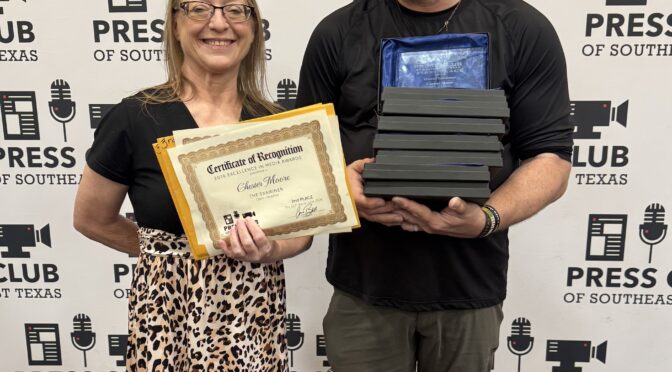
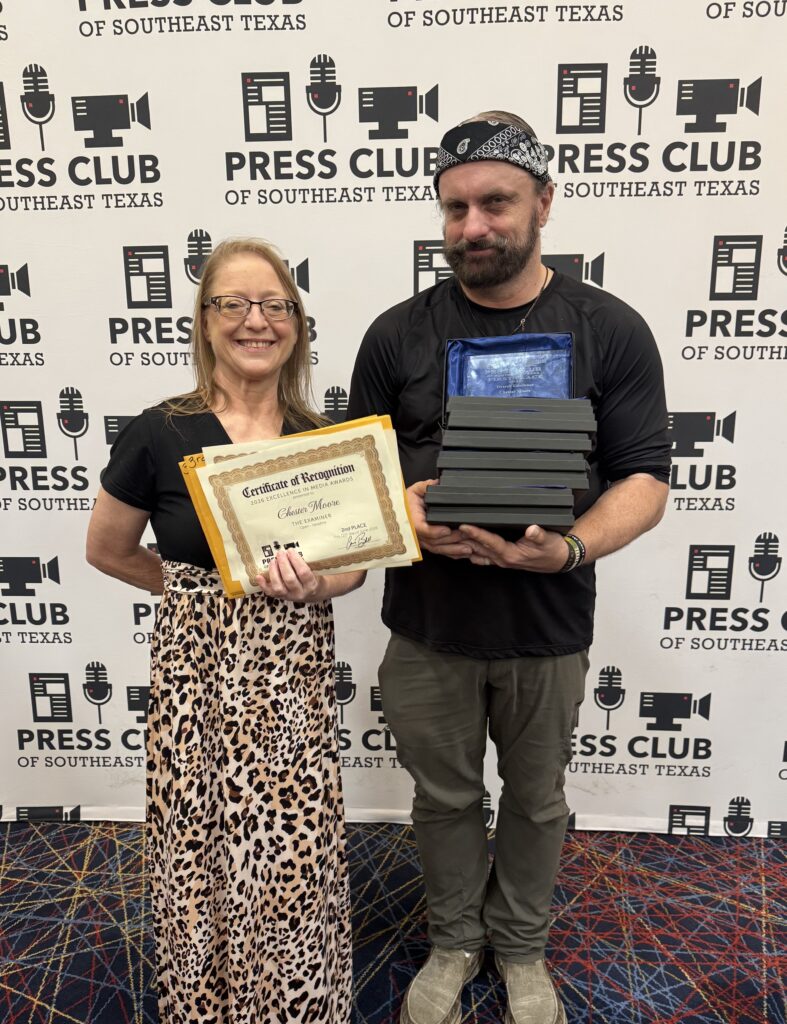
Chester Moore and his wife Lisa at the 2026 Press Club awards.
The award marks the third consecutive year Dark Outdoors has received top honors for podcasting excellence, underscoring the program’s impact and growing audience.
Earlier this year, the Dark Outdoors Podcast also earned Best Podcast honors from the Texas Outdoor Writers Association, giving the program major recognition from both mainstream media and outdoor media organizations.
Dark Outdoors explores the intersection of true crime, unsolved mysteries, and human-wildlife conflict through compelling storytelling rooted in the outdoors.
“Winning for Overall Podcast Excellence is especially meaningful because it recognizes the entire program,” Moore said.
“It is an honor to be recognized among such a talented group of hardworking journalists and media professionals. The Excellence in Media Awards showcase some of the best work being done in our region, and I am grateful to be included among those recognized.”
The Dark Outdoors Podcast features stories ranging from unsolved mysteries and true crime cases to remarkable wildlife encounters and conflicts between humans and animals. Through interviews, investigations, and narrative storytelling, the program examines stories where the outdoors and real-life events intersect.
Dark Outdoors also earned First Place for Best Video Storytelling for Wild Men in Search of Lost Trout and Feral Humanity, a documentary project created by Moore in partnership with author and investigator Lyle Blackburn and videographer/editor Paul Fuzinski.
The documentary exemplifies Dark Outdoors’ commitment to investigating unusual and compelling stories connected to the outdoors.
In addition to the podcast and documentary honors, the Dark Outdoors blog captured First Place in the Best Blog category. The blog honor further demonstrates the strength of the brand as a destination for original storytelling and investigative reporting.
“People are fascinated by mysteries,” Moore said.
“When those mysteries intersect with the outdoors and real-life events, they create stories that stay with you. Dark Outdoors was created to explore those stories and share them with audiences in a meaningful way.”
The awards highlight the growing reach and impact of the brand as a distinctive voice in podcasting, documentary filmmaking, and digital media.
For media inquiries, interviews, or speaking engagements:
For decades, hunters, rangers, and law-enforcement officers have whispered about feral humans living deep in America’s wilderness — unseen, unrecorded, and adapted to survive where most of us would die within days.
These aren’t internet myths or cryptid campfire stories. They’re accounts from those who know the timber, who have tracked both animal and man, who understand just how hostile the backcountry becomes once the trail ends and the silence sets in.
It started with a law-enforcement helicopter flight over southeastern Oklahoma. The mission was simple: scan rugged hill country for illegal grow operations. What the pilot saw wasn’t smoke or a tarp glint. It was a human shape — barefoot, nearly naked — sprinting across broken stone at a pace no ordinary human could maintain.
When the chopper circled back, the figure was gone.
A man shouldn’t be able to disappear in terrain like that — unless he belongs to it.
And yet, in America’s wildest places, people vanish — and something else is silently moving.
Are Feral Humans Real?
Talk to enough backcountry officers and you’ll hear it eventually. The tone drops. The eyes shift. The way they phrase it changes:
“Every now and then you find sign you can’t explain.”
Hermits exist. So do fugitives and anti-government extremists, families who fled society decades ago, and mentally unstable wanderers who simply stepped off the world.
But those cases — the off-grid cabins, the hermit camps — leave trails. Trash pits. Rusted cookware. Clothing scraps. Bottles. Wire. Human fingerprints on life.
Increasingly, what’s reported isn’t that.
What’s reported are encounters with people without gear, without language, without hesitation — moving with predatory efficiency, not confusion.
People who look feral not from a bad month, but from a lifetime outside civilization.
The difference matters.
A lost hiker looks desperate.
A feral human looks like they belong in the woods.
The Day the Woods Took a Child – The Dennis Martin Case
June 14, 1969. Great Smoky Mountains National Park.
Six-year-old Dennis Martin vanishes during a family trip. Search teams comb ridgelines. Special Forces assist. A grid search covers miles.
They find nothing.
Except a strange report, often dismissed officially but never forgotten by rangers:
Miles away, a family sees a wild-looking man crashing through brush, carrying something over his shoulder. A child’s scream had echoed moments before.
Officials separated the sightings.
Rangers never fully did.
The Smokies have more disappearances than any other U.S. park. Some are tragic but explainable such as hypothermia, falls, wildlife attacks.
But a select few — footprints that climb vertical brush, clothing folded instead of torn, bones found where they shouldn’t be — feel interrupted, not accidental.
When the Night Talks Back
Spend enough years hunting remote country and you’ll hear the stories whispered over a late-night campfire. Not Bigfoot tales — seasoned hunters rarely default to monsters.
One Texas hunter reported a strange case via the Ducks Unlimited podcast. What the hunter thought was a hog coming in as he watched with his thermal imaging glasses got closer and appeared to be human. Then it spoke the haunting words.
“Help me.”
Fearing for his life, he fired a shot over the “person” and it didn’t move. Only a second round caused it to retreat. Then he took off back to his vehicle.
He didn’t like telling the story. Not because he feared disbelief but because he feared belief.
Some things you can’t laugh off once you’ve breathed the same air they have.
Law enforcement reported to us a strange report of a helicopter with thermal cameras following a naked man running at an intense pace while looking for illegal grows in Oklahaoma.
Shot at With a Primitive Arrow: Trinity Triangle Encounters
The Trinity Triangle in Texas is a primitive place stretching from the Big Thicket to the Trinity River down to where the Old and Lost River empties into Trinity Bay.
Old-timer game wardens talk about strange incidents there:
Hunters stalked by strange-looking humans.
Figures observed at distance, nearly naked, muscular, hair matted
A primitive arrow embedded near a warden on patrol
A modern man left society leaves trails of modern life behind. These encounters felt older — territorial, not desperate.’
Could some “feral human” reports be small remnants of lost tribe that somehow survived and cracked the code on avoiding civilization?
Watch our documentary to go into a deep-dive on this topic.
America’s Forests: Where Civilization Ends
Most Americans don’t understand land anymore. They see forests as recreational spaces — campgrounds and marked trails.
But beyond the trails lie millions of acres no boot has touched in decades. Places without names. Hollows where moonlight barely cuts through cedar. Swamps where copperheads coil like living roots. Mountain ravines where sound dies.
SAR teams call them black zones — places where GPS dies, helicopters can’t land, and search grids fall apart because the land refuses order.
These are places where a human can vanish because the land swallows them, or because someone in the land wants them swallowed.
America Has a History of Feral People
Here are a few historical example of the feral humans issue.
The Wild Man of the Navidad eluded capture for years, surviving by stealth and instinct before being discovered as an escaped enslaved man who had mastered the wilderness better than those who hunted him.
The Wild Woman of Catahoula carried a hog and a knife through swamp bottomland with no clothing, no words, and no fear.
Civilization isn’t a default state. It’s a fragile agreement. Remove structure and a human can become something primal very quickly.
Then they vanished from history — not through treaty or migration, but through disappearance.f
Anthropologists attribute it to disease and displacement. Others suggest a quieter theory: small remnants retreated into remote marshes and river bottoms nobody wanted — and stayed there.
Author Rob Riggs detailed a strange encounter a lineman had with what he said looked like primitive First Nation’s peoples in the Old and Lost River area.
In my documentary on feral humans and unexplained wilderness disappearances, law-enforcement officers, historians, and wilderness trackers spoke carefully. None claimed intact civilizations hidden away.
But several admitted there is room for small, isolated pockets — families or clans who never re-entered society, who intermarried, learned the land, and passed down silence as a survival strategy.
Anthropology gives them the possibility. History gives them the precedent. The wilderness gives them cover.
Why the Bigfoot Stories Matter — But Not How You Think
I don’t write many Bigfoot articles.
But many so-called Bigfoot behaviors match feral human presence better than primate cryptids:
Territorial rock throwing
Nocturnal camp watching
Food theft, not trash scavenging
Predatory silence
Human-shaped bare prints
Sometimes the supernatural theory exists because the real one is worse:
Believing in an ape is easier than believing in humans feral enough to hunt you.
The Psychology of Ferality
A human raised without society:
Doesn’t fear judgment
Doesn’t understand remorse
Learns hunger as primary truth
Understands violence as survival
Has no language for empathy
Studies prey like a predator does
People think feral means dumb.
It doesn’t mean dumb at all.
It means unbound. It means instinct restored. It means no brakes where society installs them.
Tracking the Untrackable
Veteran trackers tell me the most disturbing sign isn’t prints — it’s lack of them.
A person without gear leaves little trace:
No plastic
No paracord
No boot tread
No food wrapper
Someone who has learned to move barefoot, crouched low, staying in leaf-soft corridors, traveling at night — can ghost through timber without leaving readable sign.
A law enforcement officer I interviewed told me the following.
“This ‘wild man’ we tracked whoever or whatever he was, was staying on an island and didn’t leave any signs like plastic wrappers, bottles or anything like that. It was strange.”
I spent years collecting stories of strange goings on in the woods, many I didn’t ask for. They just came to me. When I started putting things together that led me down this path I decided to write a book on feral humans.
If you think you know America’s wild places, think again.
The new documentary Wild Men: The Search for Feral Humans, Lost Tribes & Primitive Humanity takes you beyond the edge of civilization—into the deep wilderness where the line between man, myth, and memory disappears.
Filmed in out of the way places in Texas, Wild Men explores the shocking possibility that humans who vanished from history may still walk among us.
For more than a century, it’s been home to eerie lights, strange cries in the nigh and shadowed figures moving through the trees.
Wildlife journalist Chester Moore and researcher-author Lyle Blackburn set out to separate fact from legend—and what they found blurred both.
Subscribe to our newsletter!
Are these remnants of the lost tribes, still living deep within the Texas wilderness? Or modern survivalists who chose to disappear, living primitive and feral by choice? Wild Men follows Moore and Blackburn as they trace the evidence—through the Big Thicket, across the Old and Lost River, and into a world that feels untouched by time.
This isn’t a monster hunt. It’s a revelation.
Wild Men forces us to ask questions we’d rather avoid: What happens when people abandon civilization? Do they become something else? Or have we simply forgotten what we once were?
Watch Wild Men: The Search for Feral Humans, Lost Tribes & Primitive Humanity today here.
Experience the truth for yourself—and help uncover the mystery that refuses to fade.
Watch it. Share it. Comment.
If you have had similar encounters email them to chester@chestermoore.com. We would love to add them to our growing database.
Follow Chester Moore on the following social media platforms