Tag Archives: hog hunting

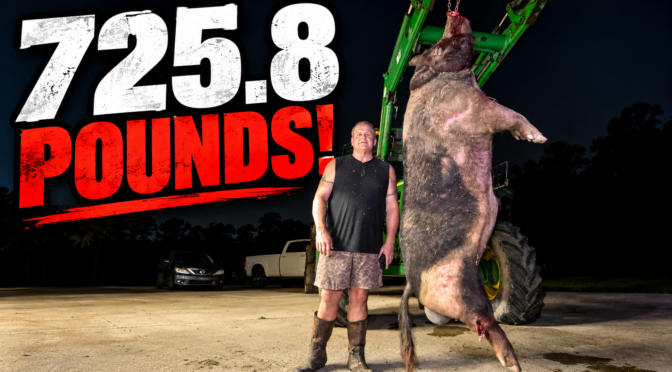
725-Pound Wild Boar Looks Almost Too Big to Be Real

I’ve seen some huge feral hogs over the years, but the animal featured in my newest video is in another category altogether.

A Texas hunter killed a massive black-and-white boar in Southeast Texas that tipped the scales at 725.8 pounds.

And that’s not an estimated weight.

There’s a photograph showing the hog on the scale with a reading of 725.8 pounds, and I was able to review documentation, video and information surrounding this incredible animal.

Watch the video here.

The hog had recently begun appearing on game camera. This wasn’t an animal Swenson had been watching grow for years. It showed up—and it was enormous.

One thing that will immediately get people’s attention is the coloration. The animal has a striking black-and-white pattern that might cause some viewers to wonder whether they’re really looking at a free-ranging feral hog.

That coloration is absolutely within the documented range for feral hogs.

Texas A&M AgriLife Extension reports feral hog coat color and pattern are highly variable. They may be black, brown, red, white, spotted or “belted.” AgriLife specifically describes belted hogs as black or brownish-red with a white band across the shoulders and forelimbs.

I’ve personally taken a couple of free-ranging hogs over the years with a similar black-and-white pattern. None of them were remotely close to this animal’s size.

Color alone also doesn’t tell us the precise ancestry of an individual hog. Texas feral hogs have a complicated history involving domestic swine, free-ranging hogs and Eurasian wild boar.

There have been plenty of “Hogzilla” stories over the years. Some involved estimated weights. Others came with very little documentation.

That’s why this one got my attention.

725.8 pounds was on the scale.

In the new video, I take a close look at the animal, the evidence surrounding it and just how unusual a free-ranging hog of this magnitude really is.

The outdoors has a dark side—and sometimes it has a really, really big one.

Chester Moore
Dark Outdoors®

Dark Outdoors investigates terrifying encounters, unsolved mysteries, true crime and dangerous wildlife—because the outdoors has a dark side.

Follow Chester Moore on the following social media platforms

Chester Moore’s YouTube.

@thechestermoore on Instagram

@gulfgreatwhitesharksociety on Instagram

To support the efforts of Higher Calling Wildlife® click here.

Subscribe to the Dark Outdoors podcast on all major podcasting platforms.

Higher Calling Wildlife on Facebook

Email Chester at chester@chestermoore.com.

The Strange “Polar Bear Hog”: What Happens When Domestic Animals Go Wild

At first glance, the hog looks wrong.

Thick white fur. A heavy, rounded body. A shape that doesn’t belong in Southern pine woods. In a single trail camera frame, it looks less like a feral hog and more like something out of place, almost unreal.

Raul Alcocer sent me this photo and I showed it to a hog hunter-trapper and he called it a “polar bear hog.”

The name stuck.

Check out the full video analysis here.

But behind the humor is a more uncomfortable truth. This animal is real, and its existence points back to human decisions that continue to reshape the wild in unpredictable ways.

The photo shows a massive white, woolly hog moving through a forest clearing. It doesn’t resemble the lean, dark feral hogs most hunters know. The coat is thick. The body is heavy. The overall look is startling enough that experienced outdoorsmen questioned what they were seeing.

As the image circulated, similar stories followed. Reports of giant white hogs, unusually thick-coated pigs, and animals that didn’t match modern expectations of wild hogs at all began coming in from across the South.

This isn’t a mystery species. It’s the long shadow of escaped and released domestic animals.

For generations, pigs were imported, bred, traded, abandoned, and sometimes intentionally released. Some were heritage breeds with thick coats and heavy builds. Others escaped farms or were turned loose when they became difficult to manage. Once those animals entered the wild, there was no undoing it.

Their genetics didn’t disappear. They spread.

Over time, those traits mixed into feral populations, resurfacing decades later in animals like this one. The result can be hogs that look nothing like what people expect, even though they are entirely real.

Feral hogs are already one of the most destructive invasive species in North America. They damage crops, destroy habitat, spread disease, and alter ecosystems. Adding unpredictable genetics into the mix only compounds the problem.

Large, heavy-bodied hogs with thick coats may survive colder conditions better, range farther, and compete more aggressively with native wildlife. What began as a domestic decision, a release, an escape, or a failure to contain, becomes a long-term ecological problem.

This isn’t ancient history. It’s still happening.

The “polar bear hog” isn’t a myth or a monster. It’s a reminder. The outdoors carries the consequences of human actions long after people walk away. Animals released into the wild don’t disappear. They adapt, survive, and sometimes come back in forms no one expects.

What looks strange on a trail camera today can become a serious problem tomorrow.

I break down the image, the genetics behind woolly feral hogs, and how escaped and released animals continue to shape the wild in the full video investigation below.

If you’ve encountered unusually large, white, or thick-coated feral hogs, or have firsthand experience with animals escaping or being released, those observations matter. The outdoors is keeping score, whether we acknowledge it or not.

E-mail me at chester@chestermoore.com.

Chester Moore

Follow Chester Moore on the following social media platforms

Chester Moore’s YouTube.

@thechestermoore on Instagram

@gulfgreatwhitesharksociety on Instagram

To support the efforts of Higher Calling Wildlife® click here.

Subscribe to the Dark Outdoors podcast on all major podcasting platforms.

Higher Calling Wildlife on Facebook

Email Chester at chester@chestermoore.com.